Auskey
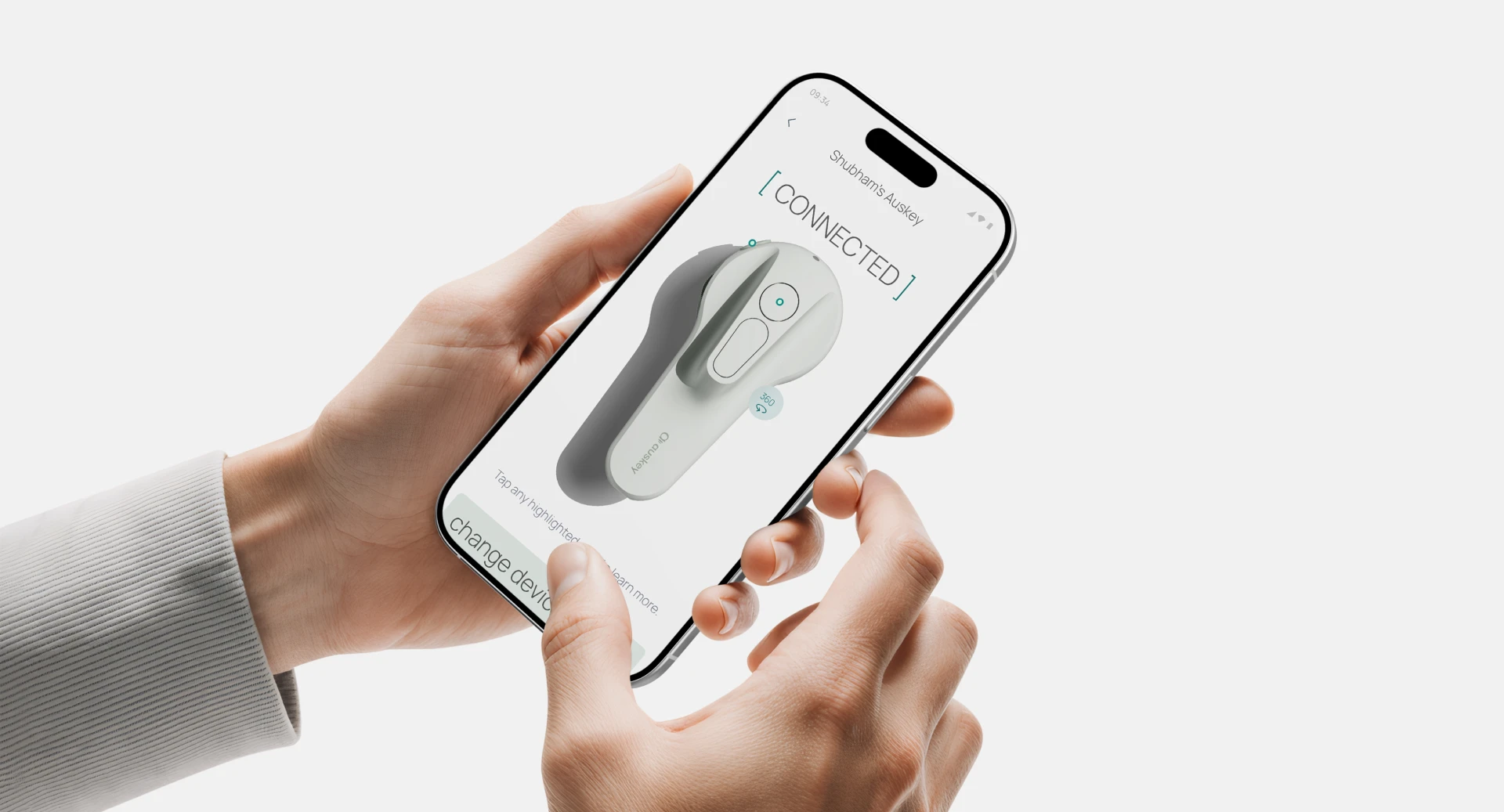
Auscultation, the practice of listening to the body, is one of medicine's oldest diagnostic skills. It is also one a generation of young doctors is quietly leaving behind. Yashraj Biotech, a company built on precision biology, set out to reverse that with Auskey: an affordable digital stethoscope for frontline diagnosis. The device itself was taking shape. The experience around it did not yet exist. That is where we started, with a companion app built from scratch.
A digital stethoscope earns its keep in software. The hardware captures a heartbeat. Everything a doctor does with that sound afterward, replaying it, cleaning it up, separating the heart sounds from the lungs, storing it, sharing it, happens in the app. So the app was never a companion in the decorative sense. It was where the product became useful.
We started before a single screen. Auskey arrived with a working technology and only a rough conception of the digital side, so the first job was to decide what the product should even be. We ran alignment sessions with Yashraj's stakeholders and their core tech team, scoping features against a hard question: what does a busy doctor actually need in the ninety seconds they'll give this?
The answer guided everything. Our users were doctors, and increasingly younger ones, first or second year into practice. So we designed the flow to disappear. Recording an auscultation takes one or two taps and feels close to what a doctor already does with an analog scope. The deeper tools, patient tagging, clinical notes, sound filters, wait quietly for the doctors who want them.
.webp)
Designed Calmness
A clinic is rarely a calm place. Someone is often in pain, or frightened, or waiting for news. An app used in that room should not add to it, so we made Auskey visually quiet: minimal, uncluttered, easy on a tired eye. Auskey's brand carried a pastel sage-green that we used at key moments for recall, then extended into a restrained palette that keeps the interface calming rather than clinical.
.webp)
.webp)
Privacy First
Every early-stage product hits the same wall with AI: data privacy. Our team acknowledged this and consciously closed off AI access to private medical records. Instead, we used AI to generate automatic tag suggestions. This turned filing into a tap instead of a decision. Secondly, when one doctor wanted to share a recording with another, the app asked for explicit, deliberate permission rather than making sharing frictionless by default.
.webp)
.webp)
.webp)
The Product Brain
An affordable stethoscope for Indian clinics meant a device with real limits. Bluetooth as its only link, and no processing power of its own. Usually, intelligent hardware does the heavy lifting and the app narrates what it's doing. Here it was the reverse. The app had to carry the analysis and cover for what the device couldn't do, without ever letting the doctor feel the seam.
.webp)
.webp)
.webp)
.webp)
Feature Innovation
Some of our most useful output never appeared on a screen. Working through the design, we kept surfacing ideas for the engineering team. One example: a heart sound has a signature, a repeating shape of peaks you can recognise by eye. We suggested the tech team teach the software to spot that shape algorithmically, so an anomaly could announce itself to the doctor, or a nurse. Design became a way of thinking through the technology.
.webp)
Impact
Auskey has not reached the market yet, so the honest measure of this work is not adoption but clarity. Designing the experience forced the hard questions about the hardware into the open. What it could do, what it couldn't, where the intelligence should live, and sent the engineering team back with sharper problems to solve. If a young doctor picks up Auskey and finds themselves listening again, the design will have done its real work.
.webp)
.webp)
Jitesh Devadiga
Project Lead
Sakshi
Visual Design
Mallika
UI/UX Design
Yash Patel
UX Design
Jay Bhanushali
Project Owner
Nitin Ghor
Chief Software Engineer
Dr. Manas Mengar
Medical Mentor